Water management has become an important consideration for industrial development in Pakistan. Manufacturing facilities, processing plants, commercial developments, and industrial estates require reliable systems to manage water consumption, wastewater generation, and environmental responsibilities.
Treatment plants help businesses manage these requirements by processing water for industrial applications or treating wastewater before discharge or reuse. However, constructing a treatment facility involves more than installing tanks and equipment. It requires site planning, civil engineering, structural design, process coordination, regulatory consideration, and long-term operational planning.
For industrial owners, understanding treatment plant construction requirements before starting a project can help reduce construction risks, improve coordination, and support more reliable facility operations.
This guide explains the major considerations involved in treatment plant construction in Pakistan, including engineering requirements, environmental compliance, construction stages, cost factors, and contractor selection.
1. Why Treatment Plants Are Becoming Essential for Industrial Development
Industrial facilities generate wastewater through manufacturing, processing, cleaning, cooling, and other operational activities. Depending on the industry, this wastewater may contain suspended solids, organic matter, chemicals, oils, or other contaminants that require appropriate treatment.
Treatment plants help businesses manage these wastewater streams and support responsible water use.
For industrial owners, treatment infrastructure can contribute to:
- Better wastewater management
- Reduced environmental impact
- Compliance with applicable discharge requirements
- Water recovery and reuse opportunities
- Improved industrial utility planning
- More organized facility operations
Treatment plants are particularly relevant for industries such as textiles, food processing, chemicals, manufacturing, and other businesses with significant water requirements.
Their construction should be considered during the initial planning of industrial facilities rather than treated as an additional requirement after production buildings are completed.
A coordinated approach to industrial design services can help integrate treatment infrastructure with factory layouts, production areas, utilities, and supporting facilities.
2. Water Treatment vs. Wastewater Treatment: Understanding the Difference
Although the terms are sometimes used interchangeably, water treatment and wastewater treatment serve different purposes.
Water Treatment Plants
Water treatment plants process raw water to make it suitable for a specific application. Depending on the source and intended use, treatment may involve filtration, clarification, softening, disinfection, or other processes.
Industrial water treatment requirements vary according to the equipment and production activities that depend on water quality.
Wastewater Treatment Plants
Wastewater treatment plants process water that has already been used in industrial or other activities.
Their purpose is to reduce pollutants and prepare wastewater for an intended discharge or reuse application.
Industrial wastewater treatment may require different treatment stages depending on the characteristics of the wastewater.
For example, a textile facility may generate wastewater containing dyes, chemicals, and suspended materials, while a food processing facility may produce wastewater with a different organic load.
Treatment requirements should therefore be established through appropriate wastewater characterization and process engineering.
The distinction matters because the treatment process determines the equipment, infrastructure, storage arrangements, and construction requirements of the facility.
3. Site Selection and Planning Before Construction Begins
The location of a treatment plant influences its construction cost, operational efficiency, maintenance access, and relationship with the surrounding industrial facility.
Before construction begins, industrial owners should evaluate the available land and determine how the treatment plant will connect with existing or planned infrastructure.
Important site planning considerations include:
Available land: The site should accommodate treatment units, equipment, access routes, maintenance areas, and any future expansion requirements.
Ground conditions: Soil investigation helps establish appropriate foundation requirements and identify potential construction challenges.
Drainage and elevation: Site levels should support suitable drainage arrangements and minimize unnecessary excavation or pumping requirements where practical.
Wastewater collection: The treatment plant should be positioned to support efficient collection of wastewater from relevant production areas.
Utilities: Electrical supply, water, and other required services should be coordinated with the plant layout.
Access and maintenance: Equipment replacement, inspection, cleaning, and maintenance activities should be considered during planning.
Future expansion: Industrial owners should assess whether additional treatment capacity may be required as production grows.
A properly planned treatment facility should fit into the overall industrial site without creating conflicts with production buildings, vehicle movement, utilities, or other infrastructure.
Landscape design services may also support the planning of external areas, circulation, and site organization where these elements form part of the broader industrial development.
4. Engineering Design and Civil Infrastructure Requirements
Treatment plant construction involves a combination of civil engineering, structural design, process engineering, mechanical systems, and electrical infrastructure.
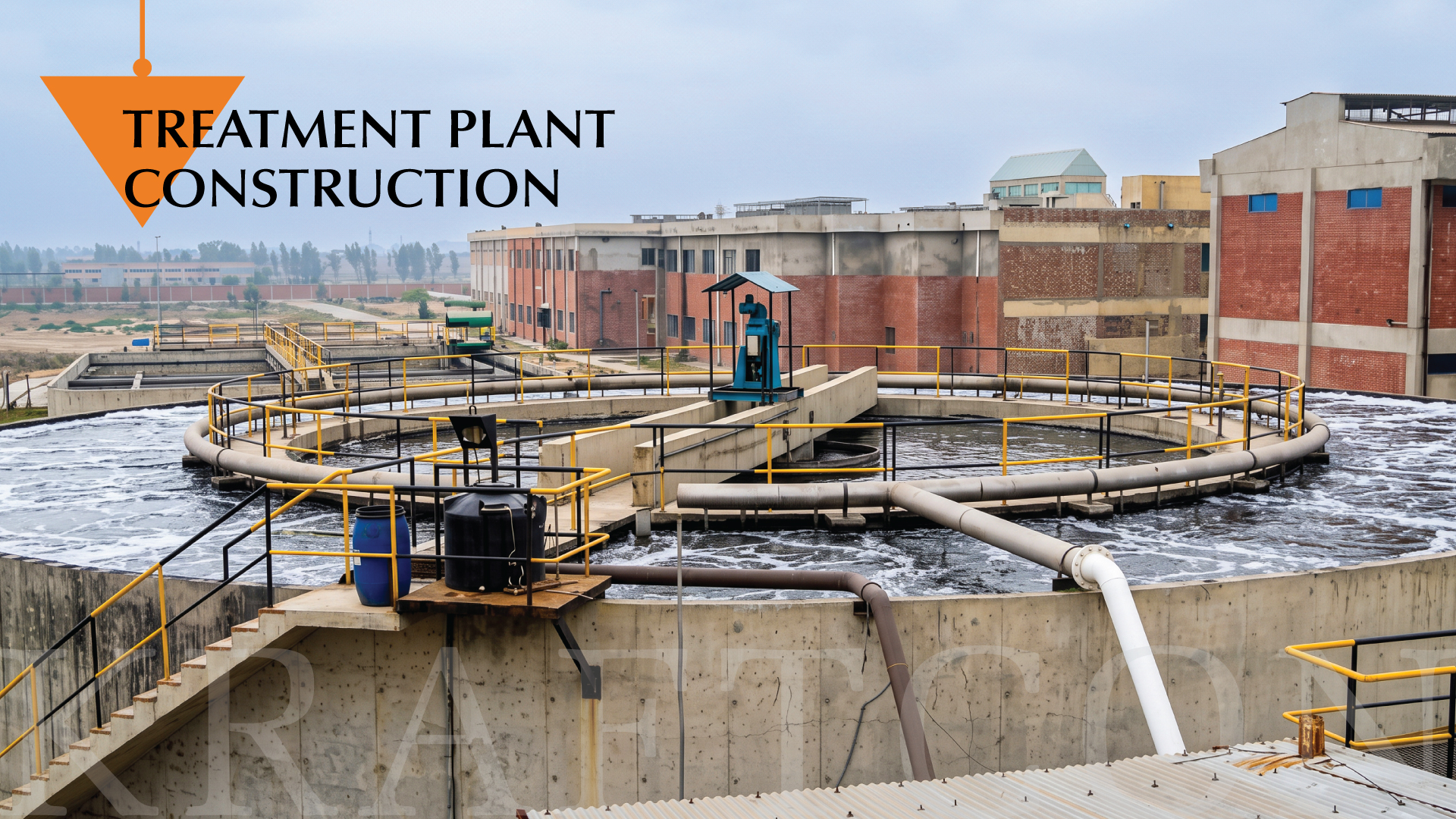
The civil construction scope may include reinforced concrete tanks, equipment foundations, treatment buildings, access roads, drainage systems, pipelines, and supporting structures.
Treatment Tanks and Structural Systems
Treatment tanks must be designed according to their intended function, dimensions, operating conditions, and applicable engineering requirements.
Depending on the treatment process, facilities may include equalization tanks, settling tanks, aeration tanks, storage tanks, and other process units.
Their structural design should consider water pressure, soil conditions, loading, durability, and relevant operating conditions.
Foundations and Ground Conditions
Foundation requirements depend on soil characteristics, tank dimensions, equipment loads, and structural configuration.
Geotechnical investigations and engineering calculations help establish appropriate foundation systems.
Waterproofing and Concrete Durability
Treatment structures may remain in contact with water or wastewater for extended periods.
Concrete quality, reinforcement detailing, construction joints, waterproofing, and protective measures should be considered according to the exposure conditions.
Equipment Foundations and Installation
Pumps, blowers, mechanical equipment, and other systems require suitable foundations and installation arrangements.
Equipment dimensions, operating loads, vibration considerations, and maintenance access should be coordinated before construction.
Pipelines and Drainage
The facility must provide suitable connections between wastewater collection points, treatment units, storage areas, and discharge or reuse systems.
Pipeline routing, access, gradients, and coordination with other infrastructure should be addressed during design.
Effective civil engineering services help coordinate these requirements and support the construction of durable treatment infrastructure.
5. Understanding Environmental Compliance in Pakistan
Environmental compliance is an important consideration in treatment plant construction because the facility’s design and operation may be subject to environmental approval requirements and applicable discharge standards.
Pakistan’s environmental regulatory framework includes the Pakistan Environmental Protection Act and relevant provincial environmental legislation. Environmental regulation and approval processes may vary according to the province, project category, and applicable authority. <Cite refs={[“turn941807search0″,”turn941807search3”]}/>
Environmental Approvals and Assessments
Depending on the project and its potential environmental impact, an Initial Environmental Examination (IEE) or Environmental Impact Assessment (EIA) may be required.
The relevant environmental authority determines the applicable assessment and approval requirements. Project owners should establish these requirements before construction begins. <Cite refs={[“turn941807search0″,”turn941807search11”]}/>
Effluent Discharge Requirements
Industrial wastewater discharge must be evaluated against applicable environmental quality standards and the conditions imposed by the relevant authority.
In Punjab, the Environment Protection Department publishes Punjab Environmental Quality Standards covering municipal and liquid industrial effluents, among other environmental categories. <Cite refs={[“turn941807search5”]}/>
The treatment system should be designed according to the wastewater characteristics, intended discharge destination, and applicable compliance requirements.
Monitoring and Testing
Environmental compliance may require wastewater sampling, laboratory analysis, monitoring, and documentation.
Industrial owners should establish how treated effluent will be tested and monitored during operation.
Important: Treatment plant construction alone does not establish environmental compliance. The process design, actual treatment performance, discharge conditions, and applicable approvals must also meet the relevant requirements.
For this reason, environmental consultants and qualified process engineers should be involved where required. Civil contractors coordinate construction activities but do not independently determine environmental approval or treatment performance.
6. Construction Materials, Quality Control, and Durability
Treatment facilities are exposed to water, wastewater, moisture, and potentially corrosive substances. Material selection and construction quality therefore have a direct impact on long-term performance.
Concrete Quality
Concrete used in tanks, foundations, and supporting structures should meet the specified strength and durability requirements.
Proper reinforcement placement, concrete placement, curing, and inspection are essential during construction.
Waterproofing
Waterproofing and joint treatment require particular attention in structures intended to contain liquids.
Construction joints, penetrations, and interfaces should be detailed and executed according to the design requirements.
Corrosion Protection
Steel components, reinforcement, equipment supports, and exposed structures may require suitable protection depending on the environment.
Protective coatings and material specifications should account for moisture, chemical exposure, and operating conditions.
Quality Inspection
Construction quality management may include:
- Reinforcement inspections
- Concrete testing
- Foundation verification
- Dimensional and level checks
- Structural inspection
- Waterproofing inspection
- Material documentation
- Construction records
Industrial building construction requires consistent coordination between engineering specifications and actual site execution.
The quality of these activities influences the durability, maintenance requirements, and reliability of treatment infrastructure.
7. Treatment Plant Construction Process: From Groundwork to Commissioning
Treatment plant construction generally follows a sequence of coordinated civil, structural, and installation activities.
The specific stages depend on the treatment technology and project scope.
Site Preparation and Excavation
Construction begins with surveying, site preparation, excavation, and establishment of required access arrangements.
Excavation work must consider soil conditions, groundwater, adjacent structures, and safe working conditions.
Foundation and Tank Construction
Foundations and reinforced concrete structures are developed according to approved engineering drawings.
Tank construction requires careful attention to reinforcement, concrete placement, curing, joints, and waterproofing details.
Building and Supporting Structures
Treatment buildings, equipment rooms, platforms, access systems, and other supporting infrastructure are constructed according to the project requirements.
Mechanical and Electrical Coordination
Process equipment, pumps, blowers, pipelines, electrical systems, and controls are installed by the relevant specialist teams.
Civil construction must provide the necessary foundations, openings, supports, and access arrangements.
Testing and Commissioning
Before operational handover, the relevant structures and systems require inspection and testing.
Civil works may undergo checks for structural integrity, leakage, and other specified requirements.
Process equipment and treatment systems require separate testing and commissioning according to their engineering and manufacturer requirements.
Handover and Documentation
Project handover should include relevant construction records, inspection documentation, drawings, and information required for operation and maintenance.
3D rendering and visualization can also support earlier planning by helping project stakeholders understand layouts, equipment locations, and the relationship between different treatment units before construction begins.
8. Common Construction Challenges and How to Manage Them
Treatment plant projects can encounter challenges when design, civil construction, and process requirements are not properly coordinated.
Poor soil conditions: Unexpected ground conditions can affect foundation design, excavation, and construction costs.
Inadequate waterproofing: Poorly executed joints or waterproofing details may result in leakage and corrective work.
Equipment coordination issues: Equipment dimensions and installation requirements may conflict with civil structures if they are not reviewed before construction.
Insufficient maintenance access: Inadequate space around treatment units can make inspections, cleaning, and equipment replacement difficult.
Design changes during construction: Changes to treatment capacity, process layouts, or equipment requirements can affect completed civil works.
Unclear responsibilities: Separate civil, mechanical, electrical, and process contractors may face coordination issues if their scopes are not properly defined.
Construction delays: Procurement delays, site conditions, design revisions, and poor scheduling can affect project completion.
These challenges can be managed more effectively through early planning, coordinated engineering, clear construction documentation, and regular project supervision.
9. Cost, Timeline, and Project Planning Considerations
The cost of treatment plant construction varies considerably depending on the facility’s purpose, capacity, treatment requirements, and construction scope.
Industrial owners should consider both civil construction costs and the wider investment required to establish an operational treatment facility.
Major cost factors include:
- Treatment capacity and process configuration
- Land availability and site conditions
- Excavation and foundation requirements
- Reinforced concrete tanks and structures
- Building and equipment support systems
- Mechanical and electrical equipment
- Pipelines and utility connections
- Waterproofing and protective materials
- Environmental assessment and monitoring requirements
- Testing, commissioning, and handover
Construction timelines depend on the complexity of the project, design completion, procurement, site conditions, and coordination between different contractors.
A realistic project schedule should include civil construction, equipment delivery, installation, inspection, testing, and commissioning activities.
Industrial owners should request clearly defined scopes, BOQs, construction schedules, and responsibilities before approving a project budget.
This approach helps distinguish civil construction costs from process equipment and specialist installation costs.
10. How to Select the Right Construction Partner for a Treatment Plant
Selecting the right construction partner is essential for establishing reliable treatment infrastructure.
Civil contractors should be evaluated according to their relevant construction experience, technical capabilities, project management practices, and ability to coordinate with specialist teams.
When reviewing potential contractors, industrial owners should consider:
- Experience in industrial building construction
- Relevant civil construction projects
- Reinforced concrete and foundation capabilities
- Construction quality management
- Waterproofing and structural execution experience
- Site supervision and safety procedures
- Coordination with mechanical and electrical contractors
- Construction scheduling and progress reporting
- Transparent quotations and contract documentation
- Previous client references
It is also important to understand the contractor’s scope.
Civil construction contractors may execute foundations, tanks, buildings, and supporting infrastructure, while treatment process design, equipment supply, and commissioning may require specialist companies.
For industrial owners, the objective should be to establish a coordinated project team with clearly defined responsibilities.
A contractor with appropriate industrial construction experience can help execute civil infrastructure according to the approved design and coordinate effectively with other project participants.
11. Building Treatment Infrastructure That Performs
Treatment plant construction requires careful planning across engineering, environmental compliance, civil infrastructure, and operational requirements.
Industrial owners should establish the treatment objectives, understand the applicable environmental requirements, and coordinate civil construction with process engineering and equipment installation.
Durable concrete structures, appropriate foundations, effective waterproofing, construction quality, and organized project management all contribute to reliable infrastructure.
Kraftcon brings a construction legacy dating back to 1968, with experience in industrial and civil construction. The company understands the importance of construction quality, engineering coordination, and practical execution in industrial developments.
Whether you are planning a treatment facility as part of a new industrial development or expanding existing infrastructure, a well-coordinated construction approach can support your project’s requirements.
Contact Kraftcon to discuss your industrial construction requirements and explore the right approach for your facility.