
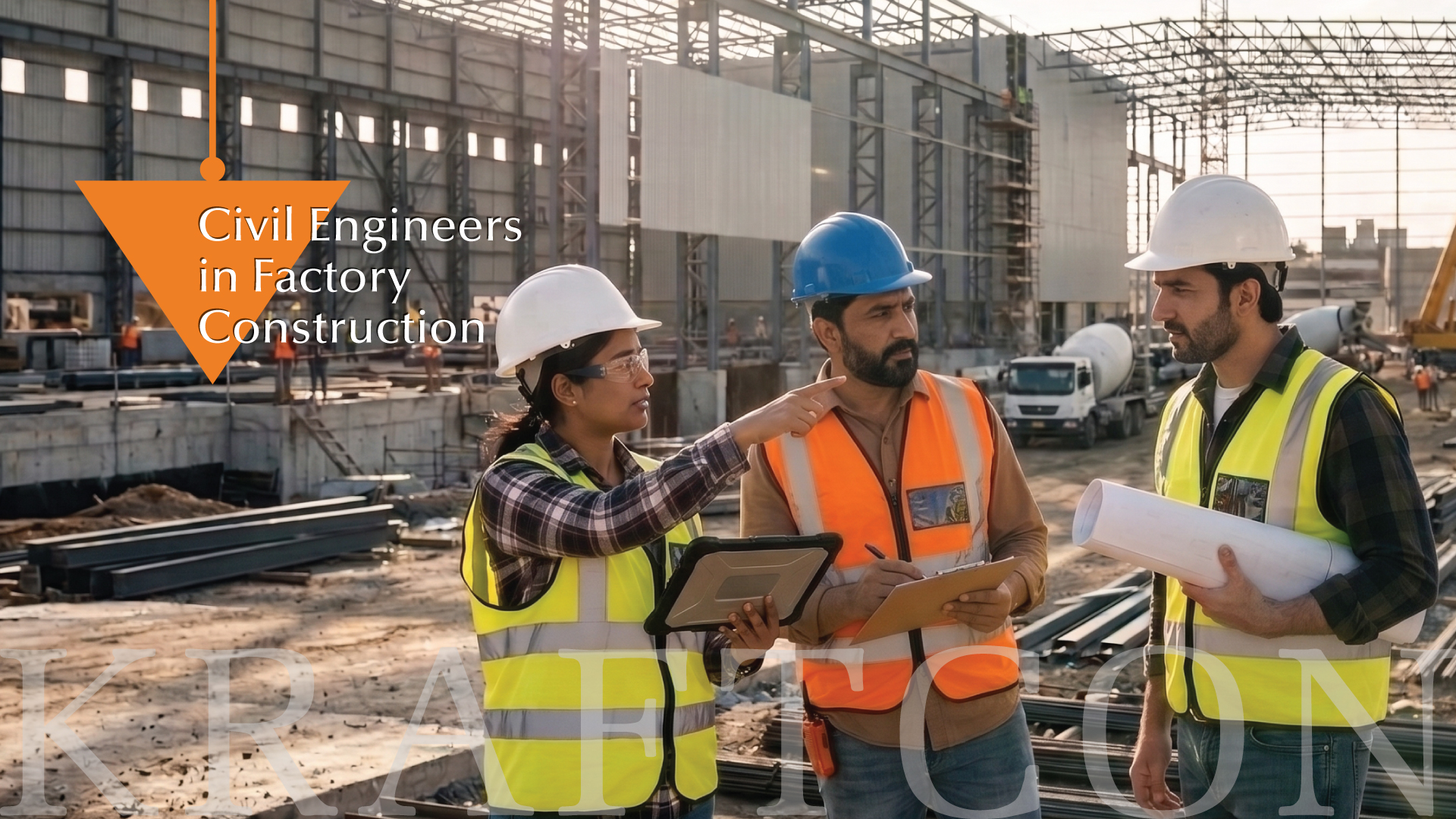
Factory construction involves much more than building walls, installing a roof, and creating a production area. Every industrial facility must be designed to support its machinery, production processes, workforce, storage requirements, transportation needs, and future expansion. This is where civil engineers play a critical role.
From evaluating the construction site to overseeing foundations, industrial flooring, drainage, and structural work, civil engineers help ensure that a factory is safe, durable, and suitable for its intended operations. Their involvement also helps project owners identify potential construction challenges before they become expensive problems.
For businesses planning a new industrial facility or expanding an existing one, understanding the role of civil engineers can make it easier to plan construction, coordinate contractors, and achieve long-term operational efficiency.
Table of Contents
- What Do Civil Engineers Do in Factory Construction?
- Key Responsibilities of Civil Engineers in Industrial Projects
- The Importance of Civil Engineering in Factory Construction
- Civil Engineers vs. Civil Contractors: What Is the Difference?
- Common Civil Engineering Challenges in Factory Construction
- How to Choose the Right Factory Civil Contractor
- Conclusion
- Frequently Asked Questions
What Do Civil Engineers Do in Factory Construction?
Civil engineers plan, design, assess, and supervise important aspects of the built environment. In factory construction, their work may include site preparation, foundation design, structural coordination, industrial flooring, drainage, internal roads, and other essential infrastructure.
Unlike many residential projects, factories must accommodate specific industrial requirements. These can include heavy machinery, production lines, material-handling equipment, high-volume storage, and frequent movement of trucks and forklifts.
Civil engineers consider these operational demands when developing construction solutions. They coordinate with architects, structural engineers, mechanical and electrical teams, and factory owners to ensure the building and its infrastructure work together.
Their responsibilities depend on the project scope, professional appointments, and the division of work among the engineering and construction teams.
Key Responsibilities of Civil Engineers in Factory Construction Projects
Civil engineers contribute at several stages of an industrial building project. Their responsibilities typically begin during planning and continue through construction, inspections, and project handover.
1. Site Assessment and Construction Planning
Before construction begins, civil engineers help assess whether the selected site is suitable for the proposed factory.
They review site levels, soil investigation results, drainage conditions, access routes, existing infrastructure, and other factors that may influence the construction design. Soil testing and geotechnical assessments are particularly important because ground conditions affect foundation selection and construction methods.
For example, a site with weak soil or a high groundwater level may require additional investigation and a different foundation or drainage strategy from a site with suitable ground conditions.
During planning, civil engineers also consider:
- Site clearing, excavation, and ground preparation
- Building levels and finished floor elevations
- Access for construction equipment and material deliveries
- Space for internal roads, parking, and loading areas
- Underground utilities and drainage routes
- Potential site constraints and future development needs
Early planning helps identify technical issues before they affect construction schedules or costs.
2. Foundation Design and Structural Coordination
Foundations transfer the loads of a building and its equipment to the ground. Their design is one of the most important considerations in factory construction because industrial facilities may contain heavy machinery, storage systems, and equipment that produces vibration.
Civil and structural engineering teams use project requirements, soil investigation data, and design calculations to determine appropriate foundation solutions. Depending on the conditions, these may include isolated footings, combined footings, raft foundations, piles, or specialized machine foundations.
Civil engineers also help coordinate foundation construction with the structural system and the requirements of machinery suppliers.
Important considerations include:
- Soil bearing capacity and settlement
- Building loads and structural column locations
- Machinery weight and operating requirements
- Vibration and equipment alignment
- Foundation dimensions and reinforcement details
- Anchor bolts, embedded components, and service openings
Poor coordination at this stage can lead to delays, rework, or difficulties during machinery installation. Proper engineering helps ensure that the foundation system suits the factory’s intended use.
3. Industrial Flooring and Load Requirements
Factory floors must support the activities taking place inside the building. Depending on the industry, they may need to withstand heavy equipment, forklifts, pallet movement, material storage, or repeated loading and unloading.
Civil engineers help establish the requirements for the floor slab and coordinate them with the structural design and operational needs of the facility.
Key factors include floor loading capacity, concrete specifications, reinforcement, joint placement, surface finish, flatness, and resistance to wear. Some facilities may also require specialized finishes for hygiene, chemical resistance, or easier cleaning.
For example, a manufacturing plant with heavy machinery may need a different flooring solution from a light-assembly facility or a warehouse that uses tall storage racks.
The flooring design should be based on actual operational requirements rather than a standard specification applied to every project. This helps improve durability, safety, and the performance of equipment used inside the factory.
4. Drainage, Water Management, and Underground Utilities
An effective drainage system helps protect a factory building, its surrounding areas, and its operations from water-related problems.
Civil engineers plan and coordinate stormwater drainage, wastewater routes, underground pipes, manholes, and other civil infrastructure according to the site’s requirements. They also consider site levels and finished floor elevations to reduce the risk of water collecting near buildings or entering operational areas.
For industrial facilities, these systems must be coordinated with production processes and mechanical, electrical, and plumbing (MEP) services.
Typical considerations include:
- Surface water drainage around the building
- Roof-water discharge and drainage connections
- Industrial wastewater requirements
- Underground water supply and utility routes
- Access for inspection and maintenance
- Protection of foundations and floor slabs from moisture
Factories that handle chemicals, food products, textiles, or other specialized materials may require additional wastewater treatment or industry-specific environmental controls. These requirements should be established with the relevant specialists before construction begins.
5. Internal Roads, Loading Areas, and Site Development
A factory is not limited to its main building. The surrounding site must also support the movement of employees, delivery vehicles, raw materials, and finished products.
Civil engineers help plan and coordinate internal roads, access points, loading and unloading zones, parking areas, boundary walls, and external drainage. These elements should be designed around the expected traffic and the types of vehicles that will use the facility.
For example, a factory receiving frequent heavy truck deliveries needs suitable turning space, pavement capacity, and loading access. Poorly planned routes can cause congestion, increase vehicle movement around workers, and disrupt daily operations.
Site development should therefore consider both construction requirements and the way the factory will function after completion.
6. Construction Supervision and Quality Control
Even a well-prepared design depends on proper execution. Civil engineers may inspect construction activities, review materials and workmanship, check dimensions, and confirm that work follows approved drawings and specifications within their assigned responsibilities.
Quality control can cover excavation, reinforcement placement, concrete pouring, compaction, floor construction, drainage installation, and other civil works.
Common quality-control activities include:
- Checking material specifications and test results
- Inspecting reinforcement before concrete placement
- Verifying levels, dimensions, and alignment
- Reviewing concrete placement and curing procedures
- Checking compaction and sub-base preparation
- Documenting inspections and resolving site issues
- Coordinating corrective work when deficiencies are identified
The specific inspection and testing plan should reflect the project design, technical specifications, applicable codes, and contractual requirements.
Consistent supervision can help identify defects early, reduce avoidable rework, and support a more reliable construction process.
7. Safety, Standards, and Regulatory Coordination
Factory construction involves excavation, heavy equipment, lifting operations, concrete work, and the movement of workers and materials. Safety must therefore be considered throughout planning and construction.
Civil engineers contribute by addressing design-related risks, coordinating safe construction sequences, and ensuring that civil work is carried out according to approved plans and applicable requirements. Construction contractors and site safety professionals also have important responsibilities for implementing safety procedures.
Projects in Pakistan may need to comply with applicable building regulations, structural design requirements, industrial-estate rules, and approvals from the relevant authorities. Requirements vary according to location, project type, and intended industrial activity.
Civil and structural documentation should be maintained as required, including approved drawings, inspection records, test reports, and revisions made during construction.
Planning these requirements early helps reduce approval delays and supports a more organized project.
8. Cost Estimation, Scheduling, and Resource Management
Civil engineering decisions influence the cost and timeline of a factory project. Site conditions, foundation requirements, material quantities, construction methods, and coordination with other trades can all affect the overall budget.
Depending on their assigned role, civil engineers may contribute to quantity calculations, technical estimates, construction schedules, material planning, and progress monitoring.
For example, identifying unsuitable soil before foundation work begins can help the project team plan excavation, replacement material, or other required measures. Similarly, coordinating underground utilities before constructing the floor slab can prevent expensive cutting and reinstatement work later.
A well-coordinated plan helps project owners understand the scope of civil works, monitor progress, and make informed decisions when changes are required.
9. Coordination With Architects, Structural Engineers, and MEP Teams
Factory construction involves several disciplines that must work together. Architectural layouts, structural systems, machinery locations, ventilation, electrical distribution, plumbing, and drainage all influence one another.
Civil engineers help coordinate the civil works with these related systems. For instance, the position of underground drainage may affect foundation construction, while machinery layouts can determine floor loading and equipment foundation requirements.
Effective coordination helps prevent:
- Conflicts between foundations and underground services
- Incorrectly positioned openings or embedded components
- Delays during machinery installation
- Rework caused by conflicting drawings
- Access and maintenance problems after handover
Regular design reviews, updated drawings, site meetings, and clear communication help keep different teams aligned throughout the project.
The Importance of Civil Engineering in Factory Construction
Civil engineering is important because industrial buildings must perform reliably under the specific demands of their operations. A factory that looks complete but has unsuitable foundations, inadequate flooring, or poorly planned drainage may experience operational problems after production begins.
The following benefits demonstrate why professional engineering and proper coordination matter.
| Benefit | Why It Matters |
| Structural reliability | Helps ensure the building and foundations are designed for the intended loads and conditions. |
| Operational efficiency | Supports suitable production layouts, vehicle access, and equipment installation. |
| Better cost control | Helps identify site risks and reduce avoidable rework. |
| Construction quality | Provides a basis for inspections, testing, and verification against specifications. |
| Water management | Helps protect the building and site from drainage-related issues. |
| Future flexibility | Allows planned expansion and utility requirements to be considered early. |
| Regulatory coordination | Supports compliance with applicable technical and approval requirements. |
These benefits depend on sound design, qualified professionals, suitable materials, effective supervision, and proper construction practices. Engineering cannot eliminate every risk, but it can help the project team identify and manage many important issues before they become more difficult to address.
Civil Engineers vs. Civil Contractors: What Is the Difference?
Civil engineers and civil contractors perform different but closely connected roles in factory construction.
Civil engineers generally focus on technical planning, design, analysis, specifications, and engineering supervision according to their appointment. Civil contractors are responsible for executing the agreed construction work, providing the required workforce and equipment, and managing site activities within their contractual scope.
Some companies provide both engineering and construction services, while other projects appoint separate consultants and contractors.
| Area | Civil Engineers | Civil Contractors |
| Main role | Engineering design, technical planning, and supervision as assigned | Execution and management of contracted civil works |
| Site preparation | Assess conditions and develop or review technical requirements | Carry out clearing, excavation, levelling, and related work |
| Foundations | Design or review engineering requirements within their scope | Construct foundations according to approved drawings and specifications |
| Quality | Establish or verify technical requirements and inspect assigned work | Implement quality procedures and deliver work to the required standards |
| Resources | Provide technical input and engineering coordination | Arrange labour, equipment, materials, and site resources |
| Documentation | Prepare or review engineering documents as assigned | Maintain construction records, test reports, and as-built information as required |
A factory civil contractor should understand the practical requirements of industrial construction, including foundation execution, reinforced concrete work, industrial flooring, drainage, and coordination with other construction teams.
Factory owners should clarify who is responsible for design, approvals, inspections, testing, and execution before the project begins. This avoids gaps in responsibility and helps ensure that technical decisions are properly implemented.
Common Civil Engineering Challenges in Factory Construction
Industrial projects can face challenges that are not always obvious during the initial planning stage. Addressing them early helps protect the budget, schedule, and long-term performance of the facility.
Inadequate Soil Investigation
Insufficient information about ground conditions can lead to unsuitable foundation assumptions, unexpected excavation requirements, or settlement concerns. A site investigation appropriate to the project should be completed before foundation design is finalized.
Underestimating Machinery Loads
Factory machinery, storage racks, cranes, and material-handling equipment can impose significant loads. The design team needs accurate equipment information to assess foundations, floors, and supporting structures.
Poor Drainage Planning
Incorrect site levels or insufficient drainage capacity can cause standing water, damage surrounding works, and disrupt factory operations. Drainage should be coordinated with the building levels and wider site layout.
Conflicts Between Civil and MEP Works
Underground pipes, electrical ducts, foundations, and equipment bases may overlap if drawings are not coordinated. Resolving these conflicts before construction reduces delays and unnecessary rework.
Choosing a Contractor Based Only on Price
The lowest quotation may not include all required work, testing, materials, or coordination. Comparing scope, technical capability, quality procedures, and project experience provides a more reliable basis for selection.
Failing to Plan for Future Expansion
Some factories eventually need additional production lines, larger storage areas, or new machinery. Where future expansion is reasonably anticipated, the design team should assess whether it can be accommodated safely and economically.
How to Choose the Right Factory Civil Contractor
Selecting a suitable contractor is an important decision for any industrial construction project. The contractor’s experience, technical understanding, workforce, and ability to coordinate with the wider project team can influence both construction quality and delivery.
Before appointing a factory civil contractor, consider the following points:
- Relevant industrial experience: Review previous factory, warehouse, manufacturing, or other industrial projects that are comparable to your requirements.
- Technical understanding: Confirm that the contractor understands foundations, reinforced concrete, industrial floors, drainage, and other civil works included in the project.
- Qualified professionals: Establish who will handle engineering design, technical reviews, site supervision, and construction execution.
- Clear scope of work: Ensure the quotation identifies included work, exclusions, materials, testing, and any provisional items.
- Quality-control procedures: Ask how materials, workmanship, inspections, and testing will be managed and documented.
- Safety and site management: Review the contractor’s approach to worker safety, equipment use, site access, and construction sequencing.
- Schedule and resources: Check whether the proposed timeline, workforce, equipment, and material arrangements are realistic.
- Documentation and communication: Confirm how drawings, revisions, progress updates, inspection records, and site issues will be handled.
- Future requirements: Discuss expansion plans, additional equipment, or changes in production needs before the design is finalized.
The right contractor is not necessarily the one with the lowest initial price. It is the one that can deliver the agreed scope with appropriate technical coordination, reliable execution, and clear accountability.
Why Professional Industrial Building Construction Matters
Industrial building construction requires a coordinated approach to engineering, site development, structural work, utilities, and operational planning. Each component must support the factory’s intended purpose.
For example, a textile manufacturing facility may have different ventilation, drainage, floor, and production-layout requirements from a food-processing plant or a general warehouse. A design that works for one facility may not be suitable for another.
This is why factory owners should involve experienced construction professionals early, provide accurate operational requirements, and ensure that design and execution teams coordinate throughout the project.
Kraftcon understands the importance of construction planning, engineering coordination, quality, and practical execution in building projects. With experience across industrial and civil construction, the company supports projects that require careful coordination between technical requirements and on-site work.
Whether planning a new factory or developing an industrial facility, choosing a team that understands the project’s requirements can help establish a strong foundation for safe, functional, and long-term use.
Conclusion
Civil engineers play a central role in factory construction projects by helping teams plan site development, coordinate foundations and structures, address flooring and drainage requirements, monitor construction quality, and resolve technical challenges.
Their work connects the factory’s physical design with its operational needs. When civil engineers, contractors, architects, structural specialists, and MEP teams coordinate effectively, the project is better positioned to meet its intended performance, quality, and schedule requirements.
For businesses planning industrial building construction, the key is to define operational needs early, appoint qualified professionals, and select a contractor with relevant experience and a clear scope of responsibility.
Planning a factory or industrial construction project? Contact Kraftcon to discuss your project requirements and explore a construction approach suited to your facility.
Frequently Asked Questions
1. What is the role of civil engineers in factory construction?
Civil engineers help plan, design, assess, and supervise civil works such as site preparation, foundations, industrial flooring, drainage, internal roads, and related infrastructure. Their exact responsibilities depend on the project scope and professional appointment.
2. Why are civil engineers important for industrial building construction?
They help ensure that the site, foundations, structural systems, floors, and infrastructure are suitable for the intended industrial operations. Their involvement also supports quality control, technical coordination, and early identification of construction risks.
3. What does a factory civil contractor do?
A factory civil contractor executes the civil works included in the project scope. These may include excavation, foundations, reinforced concrete, industrial flooring, drainage, internal roads, and other site infrastructure, depending on the contract.
4. What factors affect factory foundation design?
Foundation design depends on soil conditions, groundwater, building loads, machinery requirements, settlement limits, and the selected structural system. A suitable site investigation and engineering assessment are essential before the design is finalized.
5. How can civil engineers help control factory construction costs?
They can help identify site constraints, estimate quantities, coordinate construction activities, and resolve technical conflicts before they cause expensive rework. Cost control also depends on realistic budgeting, procurement, supervision, and project management.
6. What should businesses consider when selecting a civil contractor?
Businesses should review relevant industrial project experience, technical capability, quality-control procedures, safety practices, workforce and equipment availability, project scheduling, documentation, and the clarity of the proposed scope and quotation.
7. What is the difference between civil engineering and industrial construction?
Civil engineering provides the technical planning, design, and construction expertise needed for infrastructure and building works. Industrial construction applies these and other disciplines to facilities such as factories, warehouses, and manufacturing plants, integrating the building with its operational requirements.