Pakistan’s construction industry is entering a period of significant change. Developers, business owners, architects, engineers, and construction companies are increasingly looking beyond conventional building methods toward better energy performance, digital planning, sustainable materials, improved safety, and climate resilience.
The change is not only being driven by technology. Rising energy costs, water challenges, extreme weather, tighter project budgets, and growing expectations for efficient buildings are also influencing how projects are planned and delivered.
Pakistan’s construction sector recorded 6.61% growth in FY2025, according to the Pakistan Economic Survey 2024–25, after contracting in the previous year. This provides important context for the industry’s changing project environment.
At the same time, important regulatory developments are accelerating the shift toward more sustainable construction. In 2025, Pakistan’s Green Building Code and Rainwater Harvesting provisions were approved and incorporated into the national engineering regulatory framework.
For companies planning new industrial, commercial, or residential projects, understanding these developments can help with better long-term decisions.
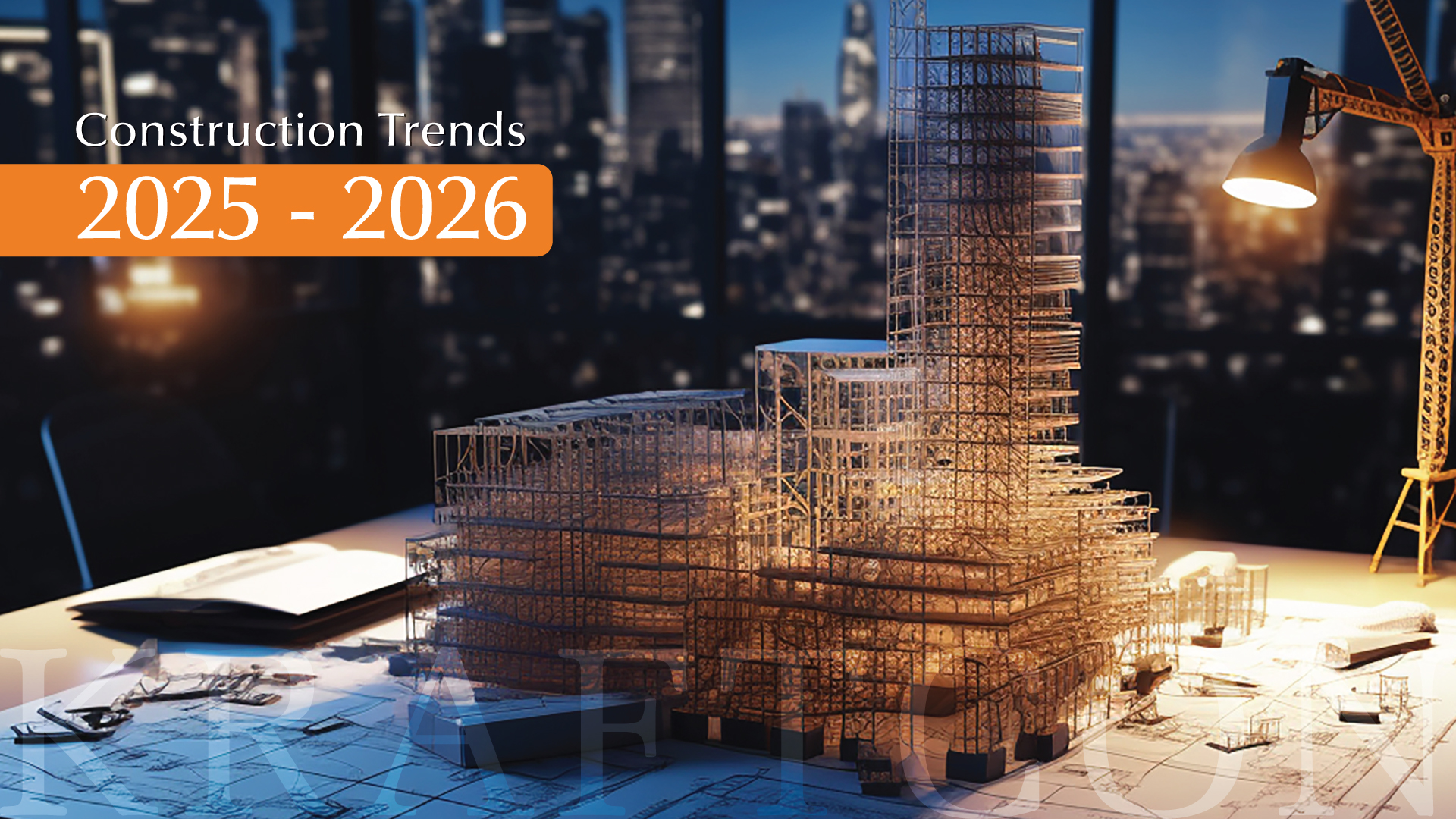
Here are the major construction trends in Pakistan to watch in 2025–2026.
Table of Contents
- Green and Sustainable Construction
- Energy-Efficient Buildings and Solar Integration
- BIM and Digital Construction
- Prefabrication and Modular Construction
- Climate-Resilient Building Design
- Smart Buildings and Automation
- Sustainable Building Materials
- Construction Safety and Quality Management
- Data-Driven Project Planning and Cost Control
- What These Trends Mean for Property Owners and Developers
- Construction Trends Checklist
- FAQs
Key Takeaways
- Sustainable construction is becoming increasingly important in Pakistan’s regulatory and development environment.
- Energy efficiency, solar integration, and water conservation are becoming central considerations in building design.
- BIM and other digital tools can improve coordination, visualization, and project information management.
- Prefabrication and modular construction are emerging as potential ways to improve speed and consistency for suitable projects.
- Climate resilience, safety, quality control, and lifecycle costs are becoming more important alongside initial construction costs.
1. Green and Sustainable Construction
One of the most important construction industry trends in Pakistan is the move toward greener buildings.
Pakistan’s Green Building Code focuses on areas including energy efficiency, renewable energy, water conservation, sustainable materials, indoor environmental quality, and building resilience. The code was approved in 2025 and notified through Pakistan Engineering Council’s regulatory framework.
This means sustainability is increasingly becoming part of the building conversation from the planning stage rather than something considered after construction.
Green construction can involve:
- Energy-efficient building envelopes
- Improved insulation
- Efficient lighting
- Solar energy
- Water-saving fixtures
- Rainwater harvesting
- Sustainable materials
- Better natural ventilation
- Reduced construction waste
- Efficient HVAC systems
For developers and property owners, the objective should not simply be to add individual “green” features. The building should be planned as an integrated system.
2. Energy-Efficient Buildings and Solar Integration
Energy efficiency is particularly relevant in Pakistan because building design directly affects cooling, lighting, and electricity requirements.
The Green Building Code includes provisions relating to energy conservation, solar design, energy-efficient lighting, and renewable energy integration.
A modern project may therefore consider:
- Building orientation
- Shading
- Insulation
- Efficient glazing
- Natural daylight
- Natural ventilation
- LED lighting
- Energy-efficient HVAC
- Solar photovoltaic systems
- Smart energy monitoring
Solar should not be treated as an isolated rooftop addition. Its integration should be considered alongside roof design, electrical systems, equipment loads, maintenance access, and the building’s overall energy strategy.
For large commercial and industrial projects, better energy performance can also become a long-term operating-cost consideration.
3. Building Information Modeling and Digital Construction
Building Information Modeling (BIM) is another important development in the future of construction in Pakistan.
BIM creates a coordinated digital representation of a building and can bring architectural, structural, MEP, and project information into a more connected workflow.
Its potential applications include:
- 3D visualization
- Clash detection
- Design coordination
- Quantity information
- Construction planning
- Facility management
- Better communication between project teams
A 2026 study involving Pakistan Engineering Council-registered firms found that BIM implementation and stakeholder coordination can influence construction project success, while also identifying barriers such as skills, organizational support, and implementation challenges.
This is important because BIM should not be viewed simply as “3D drawings.” Its value comes from using coordinated information throughout project planning and delivery.
4. Prefabrication and Modular Construction
Prefabrication and modular construction are also gaining attention as the industry looks for ways to improve construction speed, consistency, and resource efficiency.
Instead of completing every component entirely on site, selected elements can be manufactured or assembled in controlled environments and then transported to the project.
Potential applications include:
- Modular rooms
- Prefabricated structural components
- Pre-engineered systems
- Bathroom or kitchen modules
- MEP assemblies
- Industrial building components
These methods are not suitable for every project. Site conditions, transportation, design requirements, local supply chains, and project economics must all be considered.
Recent research on modular construction in Pakistan highlights adoption factors including regulatory support, market conditions, and the characteristics of the housing and building sector.
The important trend is therefore not “every building will become modular,” but rather that project teams have more construction methods to evaluate.
5. Climate-Resilient Building Design
Climate resilience is becoming increasingly important for Pakistan’s built environment.
The Ministry of Climate Change and Environmental Coordination and UN-Habitat began work in 2026 on a national urban strategy focused on challenges including flooding, heatwaves, water shortages, and unregulated urban development.
For individual buildings and larger developments, climate-resilient design can involve:
- Improved drainage
- Flood-conscious site planning
- Rainwater management
- Heat-reducing design
- Shading
- Reflective or appropriate roofing
- Natural ventilation
- Water conservation
- Durable materials
- Green spaces
The objective is to design buildings that can continue to perform under changing environmental conditions.
6. Smart Buildings and Building Automation
Smart building technology is moving beyond luxury developments.
Modern buildings can use connected systems to monitor and manage:
- Lighting
- HVAC
- Security
- Energy consumption
- Access control
- Equipment
- Indoor environmental conditions
For commercial and office buildings, these systems can provide building operators with greater visibility into how the property is performing.
The most useful smart technologies are not necessarily the most complicated. A practical system that reduces energy waste, improves security, or simplifies maintenance can provide more value than technology added simply for appearance.
7. Sustainable and Locally Appropriate Building Materials
Material selection is becoming increasingly connected to sustainability, durability, availability, and lifecycle performance.
Pakistan’s Green Building Code identifies sustainable materials and resource-efficient construction as part of the broader green-building approach.
Depending on project requirements, teams may evaluate:
- Recycled materials
- Recycled steel
- Lower-impact cementitious materials
- Efficient insulation
- Locally available materials
- Durable finishes
- Water-efficient fixtures
- Low-impact landscaping materials
However, sustainability should not mean choosing a material simply because it is marketed as “green.”
A better approach is to evaluate:
Cost + Availability + Performance + Durability + Maintenance + Environmental Impact
This helps owners make decisions based on the complete lifecycle of the building.
8. Better Construction Safety and Quality Management
Construction safety is becoming a more structured part of project management.
The Pakistan Engineering Council lists the Occupational Safety and Health Code of Practice for Construction Sector of Pakistan (OSH-CPCSP-2025) among its national construction-related codes and standards.
Effective safety management can include:
- Site induction
- Personal protective equipment
- Safe equipment operation
- Work-at-height procedures
- Electrical safety
- Emergency planning
- Site access control
- Regular inspections
- Incident reporting
Quality management is equally important.
A professional project should have clear specifications, inspection procedures, material approvals, testing where required, and documented quality checks.
For major projects, safety and quality should be managed throughout construction rather than inspected only at the end.
9. Data-Driven Project Planning and Cost Control
Construction projects are becoming increasingly dependent on accurate project information.
Owners and project managers need visibility into:
- Project budgets
- Material procurement
- Construction progress
- Labor
- Project schedules
- Quality inspections
- Variations
- Risks
- Cash flow
Digital project-management systems, BIM, quantity databases, progress reporting, and structured documentation can help teams make decisions using current project information.
This is particularly valuable for high-value projects where a small delay or uncontrolled variation can have significant financial consequences.
The goal is not to use technology for its own sake. The goal is to improve cost control, communication, forecasting, and decision-making.
10. Renovation and Retrofitting for Better Building Performance
Construction trends are not limited to new buildings.
Existing properties can also benefit from modernization.
Renovation and retrofitting may involve:
- Improved insulation
- Energy-efficient lighting
- HVAC upgrades
- Solar integration
- Water-saving systems
- Improved windows
- Better building controls
- Space reconfiguration
- Structural improvements where required
For some property owners, improving an existing building can be a practical alternative to completely replacing it.
The decision should be based on the building’s current condition, intended use, upgrade cost, expected performance, and long-term value.
What These Trends Mean for Property Owners and Developers
The biggest change is that construction decisions are increasingly being evaluated beyond the initial construction price.
Property owners should consider five broader questions:
1. What will the building cost to operate?
Energy, water, maintenance, and replacement costs can influence the property’s long-term economics.
2. How adaptable is the building?
Flexible layouts and infrastructure can make future changes easier.
3. Can the building handle environmental challenges?
Drainage, heat, water availability, and climate-related risks should be considered during planning.
4. Can technology improve project delivery?
BIM and digital project-management systems may improve coordination and information flow when properly implemented.
5. Does the construction partner understand these requirements?
Modern construction requires coordination between architects, engineers, contractors, suppliers, and owners.
The construction company should therefore be selected based on relevant expertise and project capability—not simply the initial quotation.
Construction Trends Checklist for 2025–2026
| Trend | What to Evaluate |
| Green Construction | Energy, water, materials and environmental performance |
| Solar Integration | Roof design, electrical capacity and energy strategy |
| BIM | Design coordination, visualization and project information |
| Prefabrication | Suitability, speed, quality and supply chain |
| Climate Resilience | Drainage, heat, water and site planning |
| Smart Buildings | Automation, energy monitoring and security |
| Sustainable Materials | Lifecycle cost, durability and environmental impact |
| Safety | Site procedures, training and compliance |
| Digital Project Management | Budget, schedule, procurement and progress tracking |
| Retrofitting | Energy, functionality and long-term building performance |
Common Challenges When Adopting New Construction Trends
New technology and construction methods can provide opportunities, but they also require careful implementation.
Common challenges include:
- Higher initial investment
- Limited skilled professionals
- Lack of technical training
- Availability of specialized materials
- Supply-chain limitations
- Resistance to changing established workflows
- Inconsistent implementation
- Difficulty measuring long-term benefits
For this reason, every new technology or construction method should be evaluated according to the specific project.
A solution that works well for a large commercial development may not be appropriate for a small residential project.
Frequently Asked Questions
What are the major construction trends in Pakistan in 2025–2026?
Major trends include green construction, energy efficiency, solar integration, BIM and digital construction, climate-resilient design, prefabrication, smart-building systems, sustainable materials, stronger safety practices, and data-driven project management.
Is green construction becoming important in Pakistan?
Yes. Pakistan approved and notified the Green Building Code in 2025, with provisions covering areas such as energy efficiency, renewable energy, water conservation, sustainable materials, and building performance.
How can BIM improve construction projects?
BIM can support 3D visualization, design coordination, clash detection, project information management, and communication between different project stakeholders. Research involving Pakistan’s construction sector has also examined its relationship with project success.
Is prefabricated construction suitable for projects in Pakistan?
It can be suitable for certain projects, particularly where speed, repeatability, controlled manufacturing, or standardized components provide advantages. However, project requirements, logistics, cost, design, and local supply chains should be assessed before selecting the method.
Why is climate-resilient construction becoming important in Pakistan?
Pakistan’s cities and infrastructure face risks associated with flooding, heat, water shortages, and other climate-related challenges. These risks are increasingly being incorporated into national urban-planning discussions and building strategies.
Conclusion
The construction trends in Pakistan for 2025–2026 point toward a sector that is becoming more technology-driven, sustainable, data-informed, and focused on long-term building performance.
Green construction, energy efficiency, solar integration, BIM, prefabrication, climate resilience, smart-building systems, sustainable materials, safety, and digital project management are not equally relevant to every project. Their value depends on the building type, location, budget, operational requirements, and long-term objectives.
For developers, business owners, and project managers, the most important step is not simply adopting the newest technology. It is identifying which improvements can deliver measurable value for the specific project.
At Kraftcon, construction planning is supported by decades of experience across industrial, commercial, and residential projects. With a focus on engineering, quality, project coordination, and long-term performance, Kraftcon helps clients approach modern construction requirements with practical solutions.
Planning a new construction, commercial, industrial, or residential project? Get in touch with Kraftcon to discuss your requirements and build for the future.